



The questions to ask a PPC agency before you sign matter more than the pitch, because every agency sounds good on a sales call. What separates a good partner from an expensive mistake is how they answer specific questions about who owns your account, how results will be measured, and what happens if you leave.
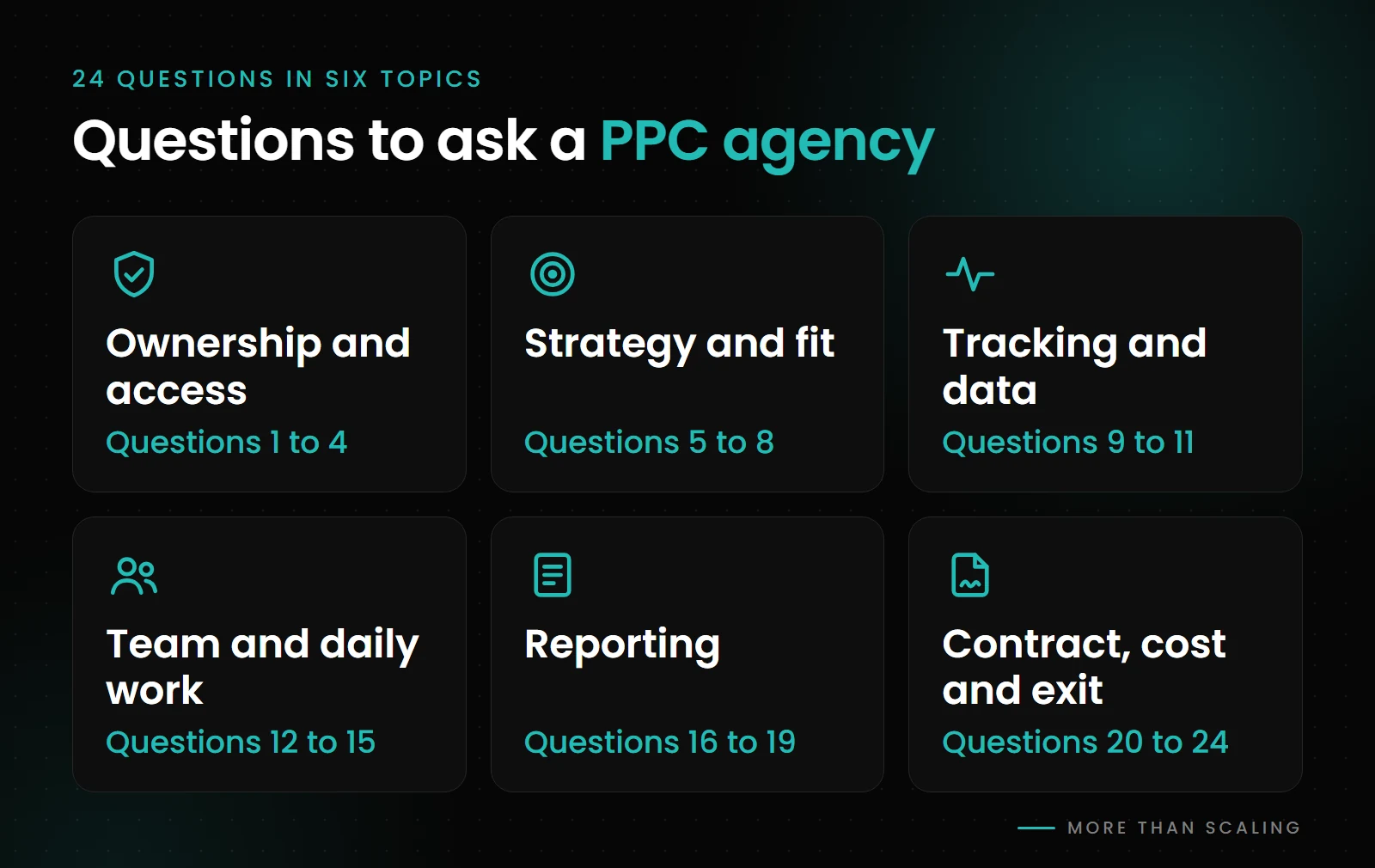
This guide gives you 24 questions grouped by topic, explains what each one reveals, and shows what strong and weak answers sound like. It is written with Google Ads in mind, but most of it applies to any paid media agency.
Table of Contents
Why the Right Questions Beat a Good Pitch
A sales call is rehearsed. Your questions are not. That is why they are the best tool you have for seeing how an agency really works.
You are testing three things:
- Honesty. Do they tell you what they cannot promise, or only what you want to hear?
- Process. Can they describe what happens in week one, month one and month three without improvising?
- Fit. Have they solved your kind of problem before, at your size, with your kind of customer?
Google expects the same from the agencies that buy ads for clients. Its third-party policies say partners should be honest and transparent about their company, services, associated costs and expected results. A good agency will be comfortable with every question below.
Before You Ask Anything: Know Your Own Numbers
An agency can only give precise answers to precise questions. Before the first call, have these four things written down.
- What a customer is worth. Your average order value, gross margin and, if you know it, how often customers buy again.
- Your recent results. Spend, conversions and revenue or leads from the last three to twelve months.
- Your goal. A number and a date, such as a target return on ad spend or a cost per qualified lead.
- Who holds access today. The people with admin rights to your Google Ads account, Merchant Center and analytics.
If you are new to the platform, our guide on how to use Google Ads covers the basics you need to follow the answers you will get.
The Questions to Ask a PPC Agency, by Topic
Account ownership and access
1. Will the campaigns run in my own Google Ads account? The answer should be yes. If the agency builds everything in an account it owns, you lose the campaigns, the history and the conversion data the day you part ways.
2. Who will hold admin access? At least one person in your business should. In Google Ads, only an admin can add or remove users, accept a manager account link, or unlink a manager. Google lists what each level can do in its guide to access levels.
3. Will you connect through a manager account, and will it have ownership? Linking through a manager account is the normal way for an agency to work in your account. Ownership is a separate setting that lets the manager edit your users. Ask why they need it if they request it.
4. If we stop working together, what do I keep? You should keep the account, every campaign, the audiences, the conversion actions and the full change history.
Strategy and fit
5. What would you look at first in my account, and why? A strong answer names specific things: tracking, search terms, campaign structure, product feed. A weak answer is a list of services.
6. Have you worked with a business like mine? Similar means the same model, price point and sales cycle, not just the same industry. Ask what was different about those accounts.
7. Which campaign types would you start with, and which would you leave for later? You are listening for reasons tied to your goal. Our guide to Google Ads account structure explains why these early choices are hard to undo.
8. When would you tell me not to spend more? Good agencies have an answer, such as when the extra spend stops paying for itself or when tracking cannot be trusted.
Tracking and data
9. How will you check my conversion tracking before changing anything? Bidding learns from conversion data. If the data is wrong, every decision built on it is wrong too.
10. Which conversions will the campaigns optimize for? For a store this is usually purchases with their value. For lead generation, ask how they will feed lead quality back into the account, so bidding is not chasing cheap form fills.
11. What will you do when Google Ads, analytics and my store show different numbers? They always differ a little. You want an agency that can explain why and agree with you on one source of truth.
Team and day-to-day work
12. Who will actually manage my account, and how many accounts do they look after? Ask to meet that person before you sign. The salesperson is rarely the one doing the work.
13. What happens in the account each week? Listen for a routine: search term reviews, budget checks, bid strategy reviews, new tests. “We monitor it constantly” is not a routine.
14. How do you decide what to test, and where is it recorded? A testing log tells you the agency learns from the account instead of making random changes.
15. What will you need from me? Creative, product feed access, landing page changes and quick approvals all affect results. Knowing this early prevents delays.
Reporting and communication
16. What will the report include, and how often will I get it? Where a monthly report is required, Google’s transparency requirements say it must include cost, clicks and impressions at the account level. A useful report goes further and ties spend to revenue or qualified leads.
17. Will ad spend be shown separately from the management fee? It should be. The same Google policy says cost data must show the exact amount charged by Google, without agency fees mixed in.
18. Who is my contact, and how fast do you respond? Agree on a named person, a channel and a response time.
19. What do you do when results drop? You want to hear a diagnosis process: check tracking, check what changed, check the market, then act.
Contracts, cost and exit
20. How is the management fee structured, and what does it include? Google requires partners to tell new customers about a management fee in writing before the first purchase. Ask what is extra, such as creative, landing pages or feed tools.
21. What is the minimum term and the notice period? Shorter is better for you. A long lock-in protects the agency from having to earn the next month.
22. Who owns what gets built? Ads, creative, landing pages, feed rules and scripts made for your business should stay with you.
23. What does offboarding look like? A professional agency can describe the handover: access removed, documents shared, nothing deleted.
24. Can I speak with two current clients? Ask those clients what happened the last time results dipped.
What Good and Bad Answers Sound Like
| Topic | A good sign | A warning sign |
|---|---|---|
| Account ownership | Your account, your admin access, the agency links as a manager | The agency wants to build in an account it owns |
| Results | A range tied to your numbers, with the conditions that must hold | A guaranteed position, return or lead count |
| Tracking | They want to audit before launching anything | “Your tracking is probably fine” |
| Reporting | Spend exactly as Google charged it, results tied to revenue | Clicks and impressions with no link to sales |
| Team | You meet the person who will run the account | Only the salesperson ever speaks |
| Exit | Short notice period and a full handover | Long lock-in, assets held back |
Treat guarantees with particular care. Google’s own advertiser guide to working with third parties points out that nobody can guarantee a specific ad position, because position is decided by an auction on every search.
How to Compare Agencies After the Calls
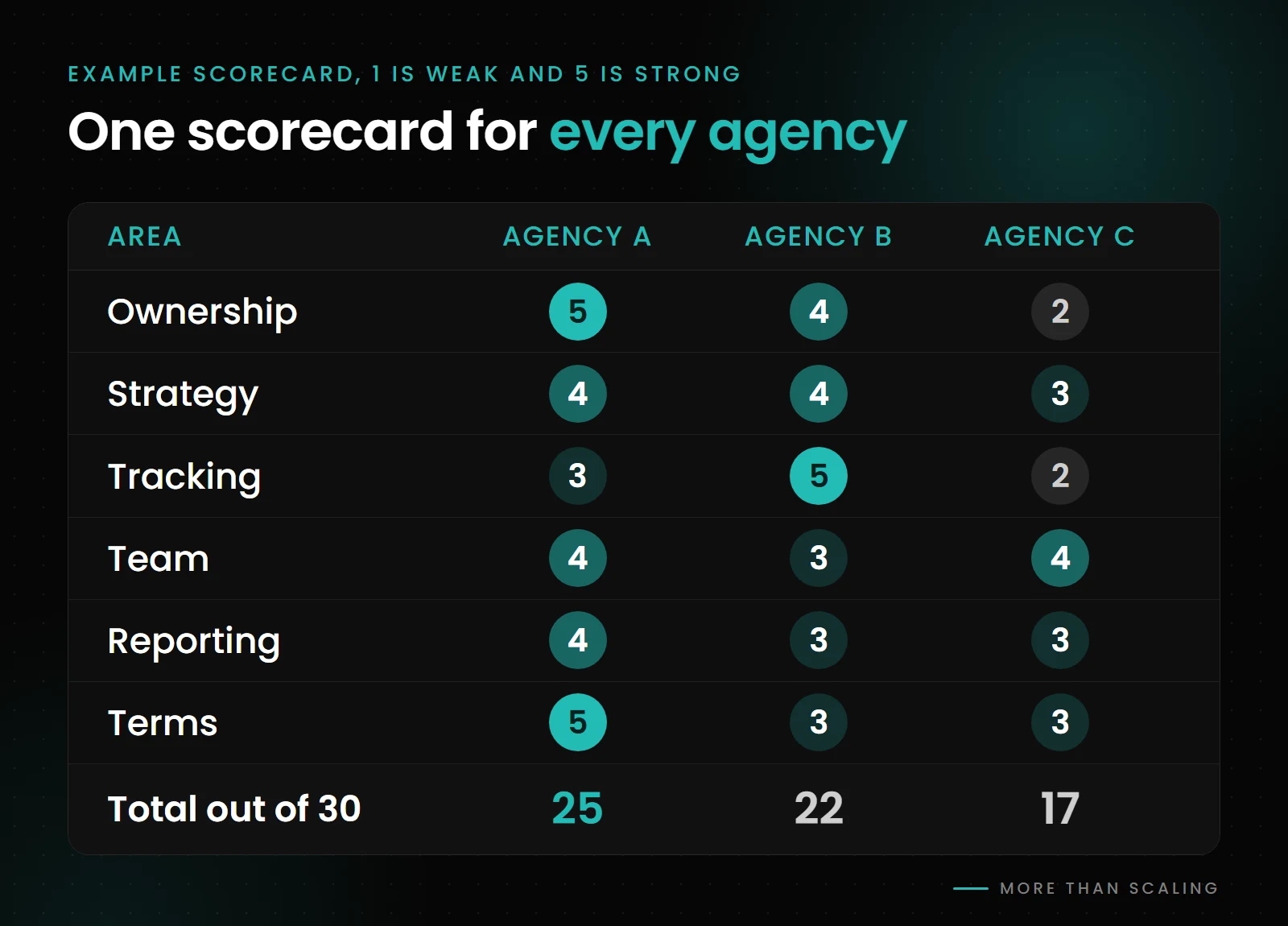
Ask every agency the same questions, in the same order, and write the answers down straight after each call. Memory favors the most charming presenter.
Then score each agency from 1 to 5 on six areas: ownership, strategy, tracking, team, reporting and terms. Decide in advance which areas matter most to you. A business with a complicated sales cycle might weight tracking twice as heavily as anything else.
Two more checks are worth the time.
- Call the references. A ten-minute conversation tells you more than a case study page.
- Start with a defined first project. An account audit or a 90-day plan lets you see the quality of thinking before you commit to a long engagement.
If two agencies score the same, pick the one that told you something you did not want to hear. That is usually the one that will keep telling you the truth.
Frequently Asked Questions
How many agencies should I interview?
Three is usually enough. Fewer gives you nothing to compare against, and more than four or five makes the answers blur together.
What is the most important question to ask a PPC agency?
Who owns the account. Every other problem can be fixed later, but if the agency owns the account you cannot take your history and data with you.
Should I ask for guaranteed results?
No. Ask for a forecast with assumptions instead. An agency that guarantees a ranking or a return is either going to disappoint you or is not being straight about the risks.
Is a Google Partner badge enough to trust an agency?
It is a useful starting point. Google says you can click the badge on an agency’s site to confirm it is real. The badge does not tell you whether the agency is the right fit for your business, which is what the questions above are for.
Put These Questions to Us
The questions to ask a PPC agency are the same ones a good agency hopes you will ask. If you would like to hear how we would answer them for your account, talk to our team. You can also see what we do on our services page and read the results in our case studies.

